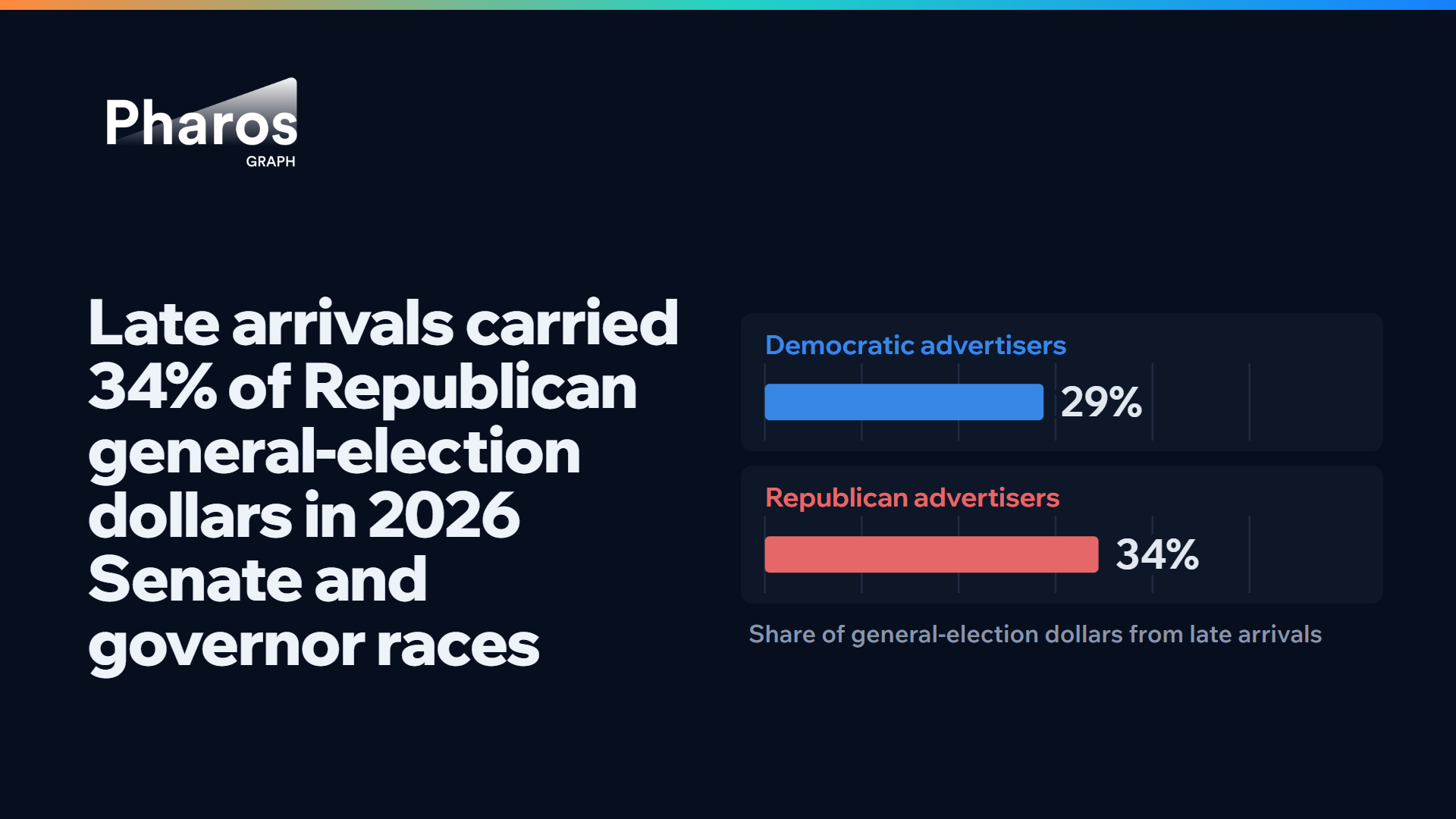
In the 2026 Senate and governor races, much of the general-election money came from late arrivals: advertisers other than the candidate whose first ad in a race aired once the general-election campaign was well under way. Late arrivals carried 29% of Democratic general-election dollars and 34% of Republican ones.
AdImpact tracked political ads from October 2025 to Election Day, and PharosGraph’s AdScape™ analyzed each one to identify the issues it covered. This post covers the 69 statewide Senate and governor contests in AdImpact’s data.
Much of the general-election money came from advertisers new to the race
The late money didn’t arrive at a steady rate. On the Republican side, the share of weekly general-election dollars from late arrivals jumped in September, from 15% in the week of September 1 to 48% two weeks later. On the Democratic side, it climbed steadily from 19% in the week of September 1 to 39% in the last week of October.
It also differed by office. Late arrivals carried 39% of Democratic and 54% of Republican general-election dollars in Senate races, against 13% and 9% in governor races. In the Texas Senate race, they carried 83% of the Republican side’s general-election dollars.
When you size the other side’s general-election air right after the primary, leave room for advertisers who haven’t entered yet. In 2026 they carried 29% to 34% of each party’s general-election dollars, and the Republican jump came in mid-September, not in the final weeks.
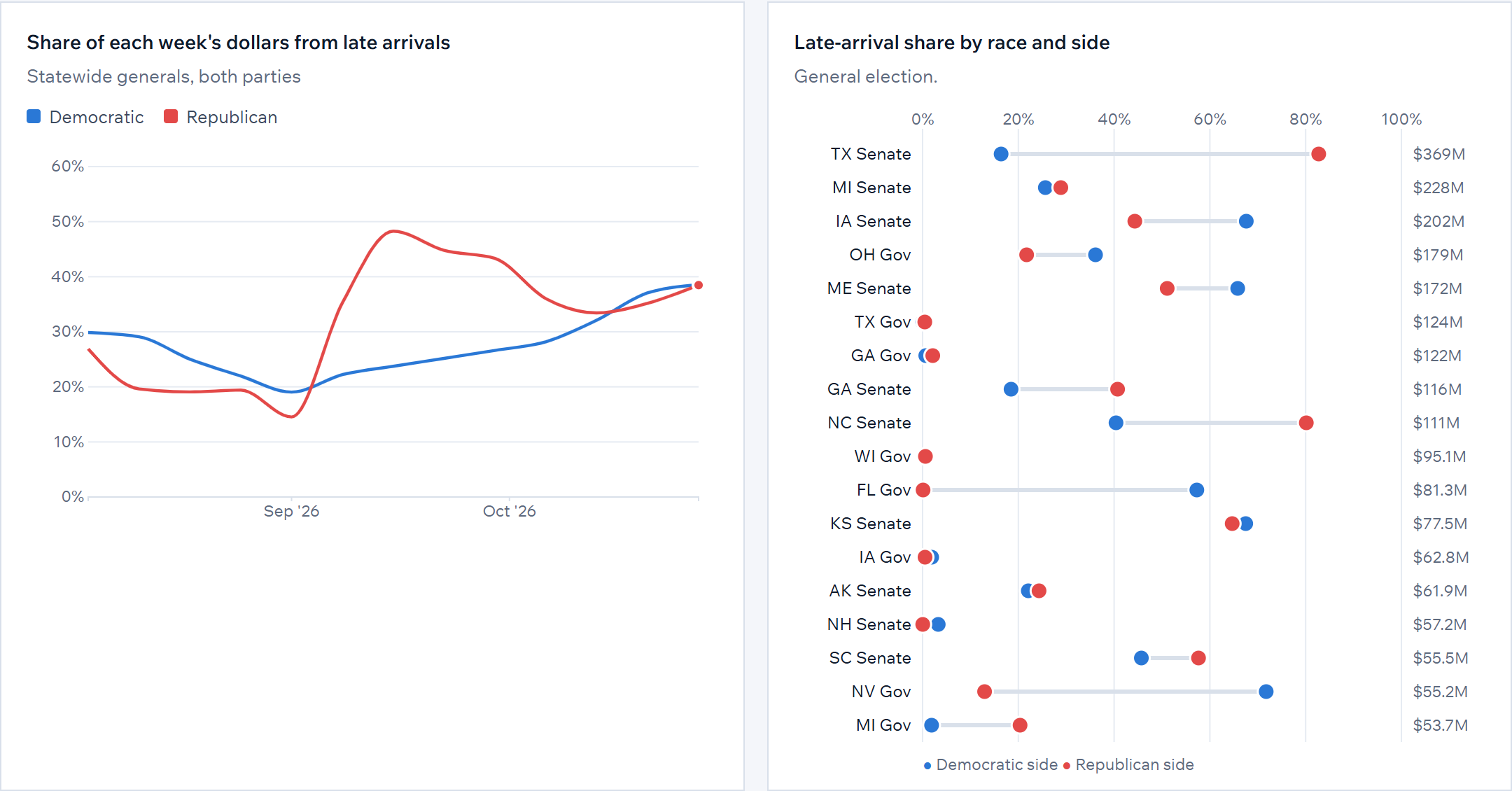
Late arrivals are counted race by race, from each advertiser’s first ad in the race and the race’s primary date.
Advertisers other than the candidate carried most of the Senate air
Across the whole general election, not just the late money, advertisers other than the candidate carried 91% of Republican general-election dollars in Senate races and 55% of Democratic ones. These advertisers include party committees and coordinated buys as well as outside groups. Governor races ran closer to the candidates. On the Republican side of governor races, advertisers other than the candidate carried 41% of general-election dollars, and on the Democratic side, 34%.
Dollars aren’t airtime, though. Candidates can buy broadcast time at the lowest unit rate, and other advertisers usually pay more for the same spot, so these shares are likely to overstate how much of a side’s airtime came from advertisers other than the candidate. Read the other side’s air in spots or ratings points as well as dollars.
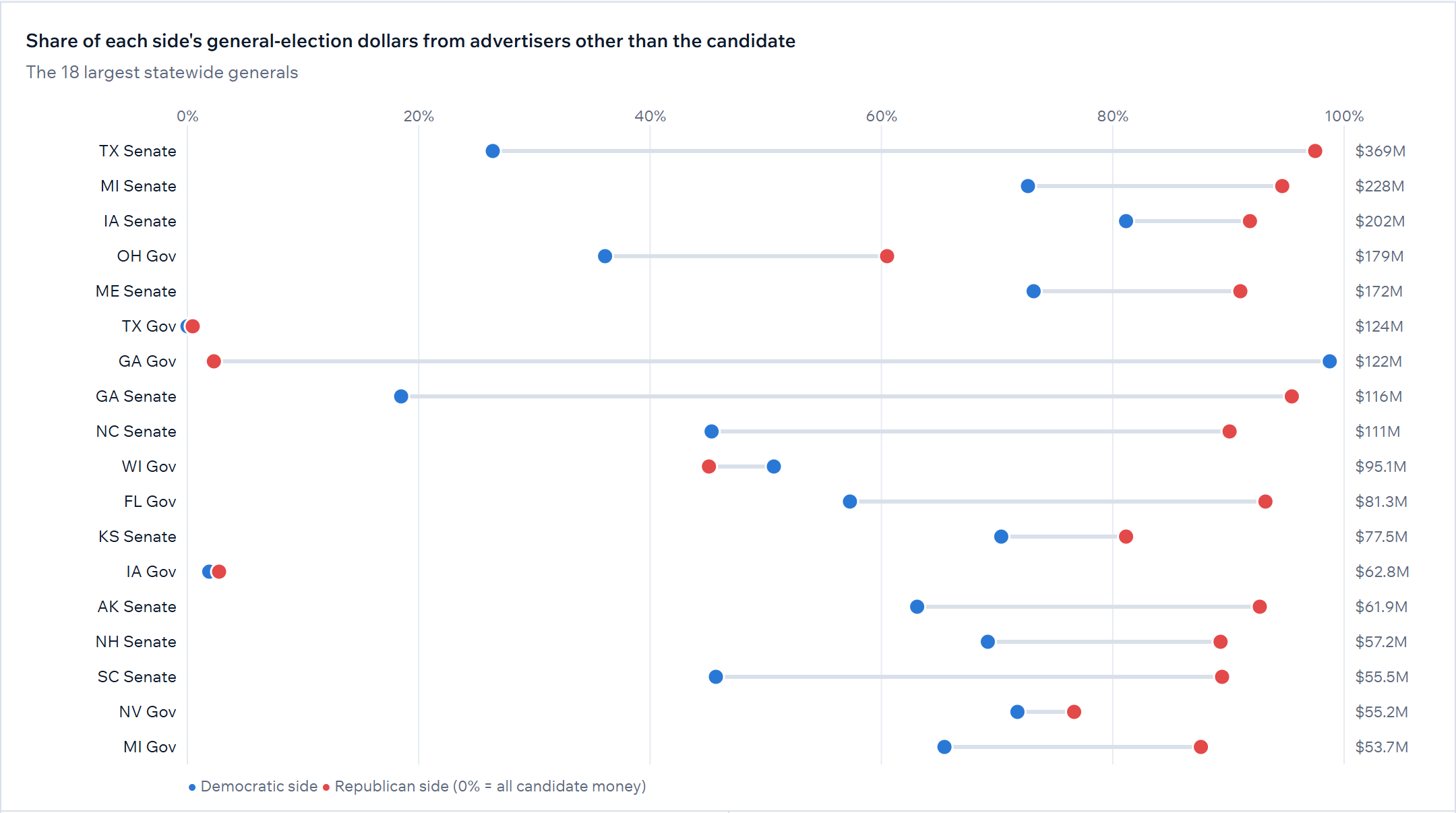
This counts everyone on a side except the candidate’s own campaign, as AdImpact identifies it.
Many messages rested on a single advertiser
About 4 in 10 issue dollars sat on messages carried by one advertiser: 42% for Democrats and 37% for Republicans.
A side’s overall air often leaned on one advertiser too. A keystone is the single advertiser a side’s air depended on most. In the 18 largest races, the governor keystone was most often the candidate, on 9 of 16 sides, and on 3 more it was a coordinated buy with the party. The Senate keystone was usually a party-aligned super PAC, on 12 of 20 sides. When it wasn’t the candidate, a Senate keystone carried between 29% and 66% of the side’s general-election dollars.
Use this to read the other side. An issue carried by one advertiser can disappear with one budget decision. An issue that several advertisers carry doesn’t rest on any one budget, and that’s the place to start when deciding what to answer.
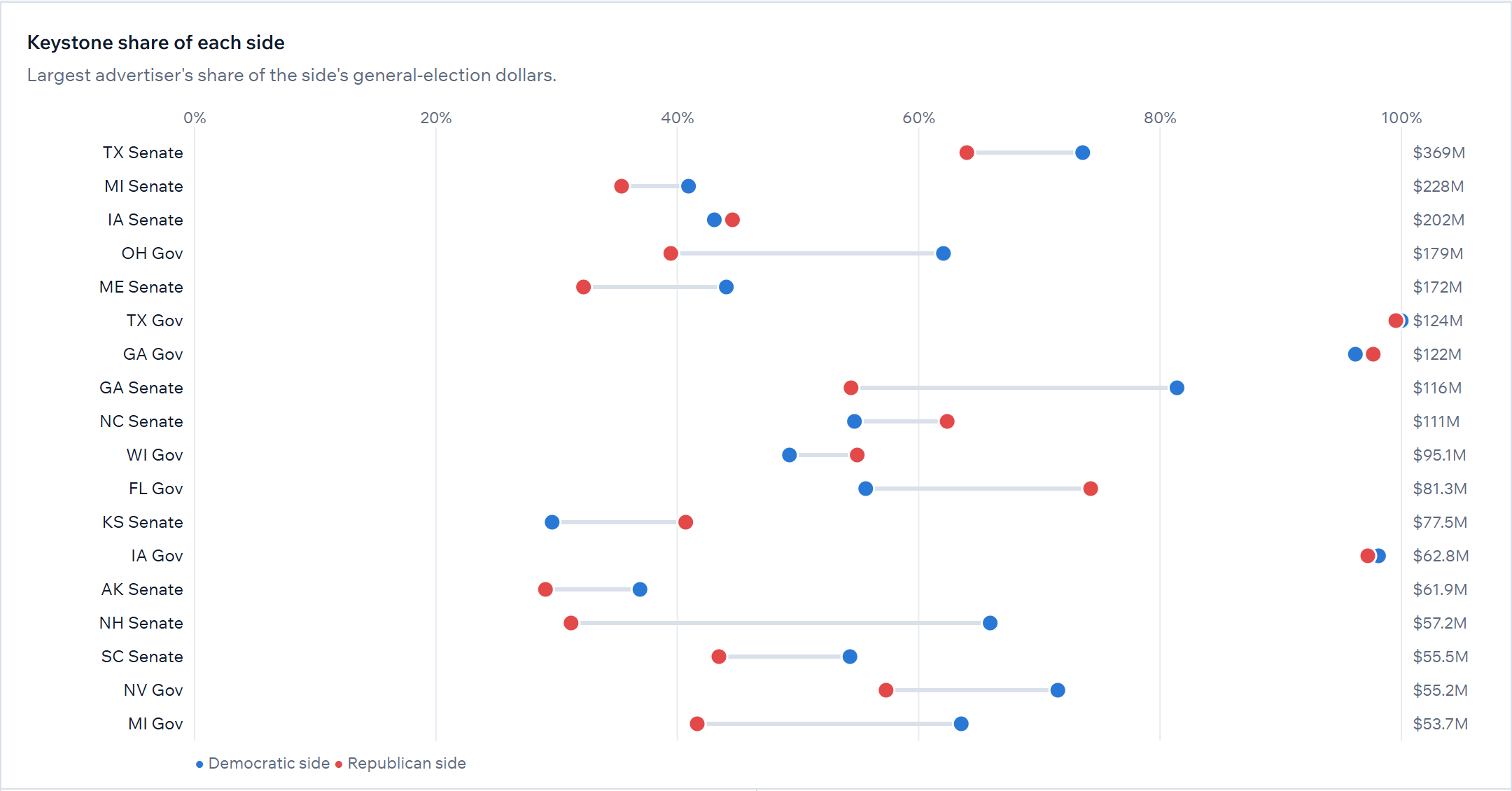
Issue dollars come from PharosGraph’s reading of each ad; advertiser dollars come from AdImpact placements.
Democrats put twice the share of their issue dollars on the other party’s issues
In statewide general-election races, Democrats put 16% of their issue dollars on Republican-owned issues, and Republicans put 8% of theirs on Democratic-owned ones. The first post in this series found much the same across all candidate races, 17% and 9%. Democrats crossed mostly on the issues of taxes and crime, and Republicans mostly on the issue of health care.
A side that crosses onto the other party’s issues is likely to be outspent there, so watch where the other side crosses and how much it puts behind each cross.
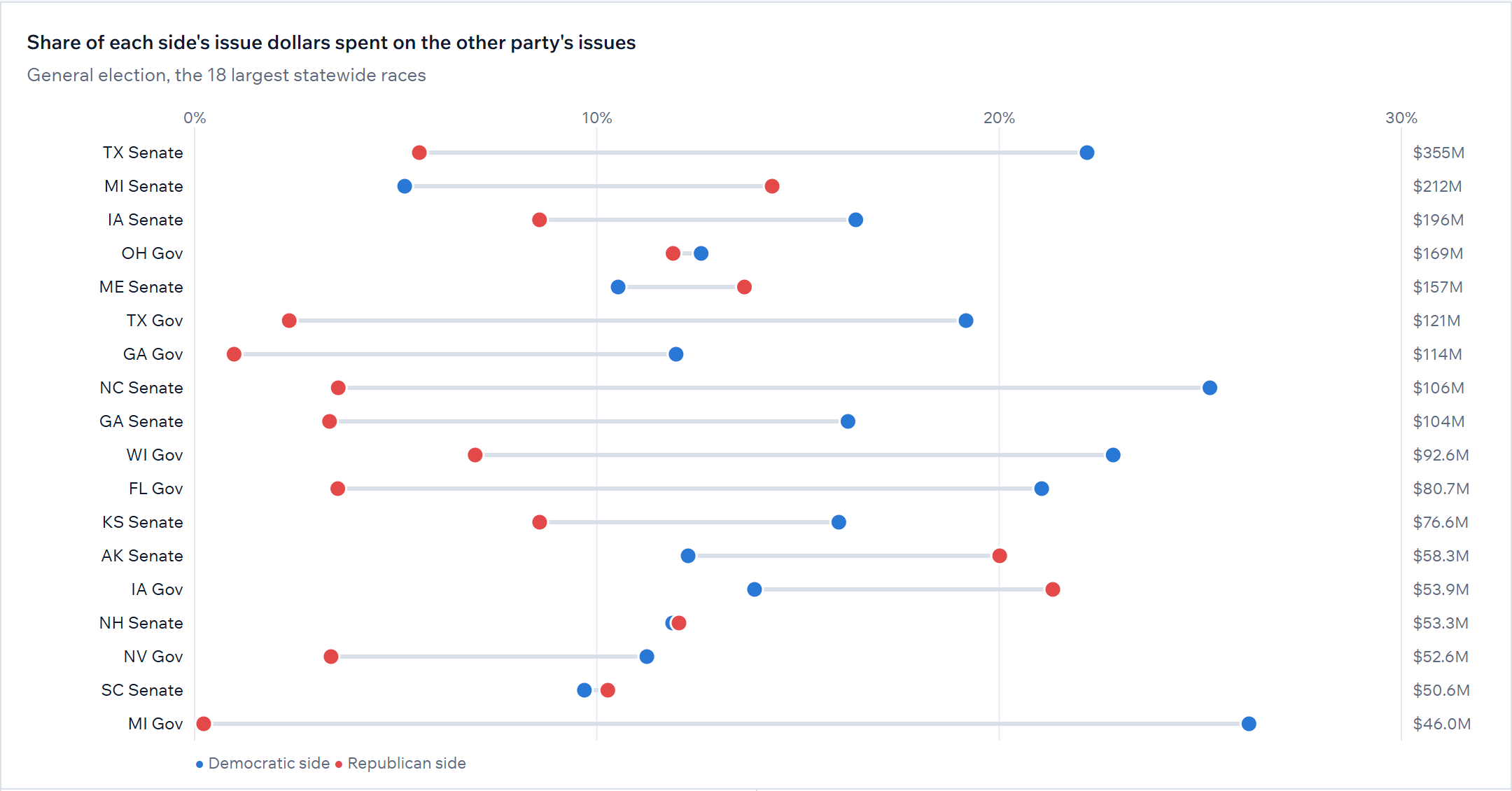
Issue ownership is the same cycle-wide definition used in the first post in this series.
All four charts are on the Flight Log companion page.
For these readings and more on a race you supported in 2026, or one you’re planning for 2027 and beyond, write to info@pharosgraph.com.
How we measured it
- Spend is AdImpact placements from October 1, 2025 to November 3, 2026, for the 69 statewide Senate and governor contests in AdImpact’s data.
- Primary and general are split race by race on each race’s primary date. Runoffs count as primary, and in top-two states the first round counts as primary.
- Party is the advertiser’s party in AdImpact’s data. Independent advertisers are left out of the party comparisons.
- PharosGraph reads each ad’s transcript and identifies the issues it covers. Ads with no policy issue are left out of the issue figures.
- These figures describe where the money went. Nothing here claims an ad moved a vote.
- The full method is on the Flight Log methods page.