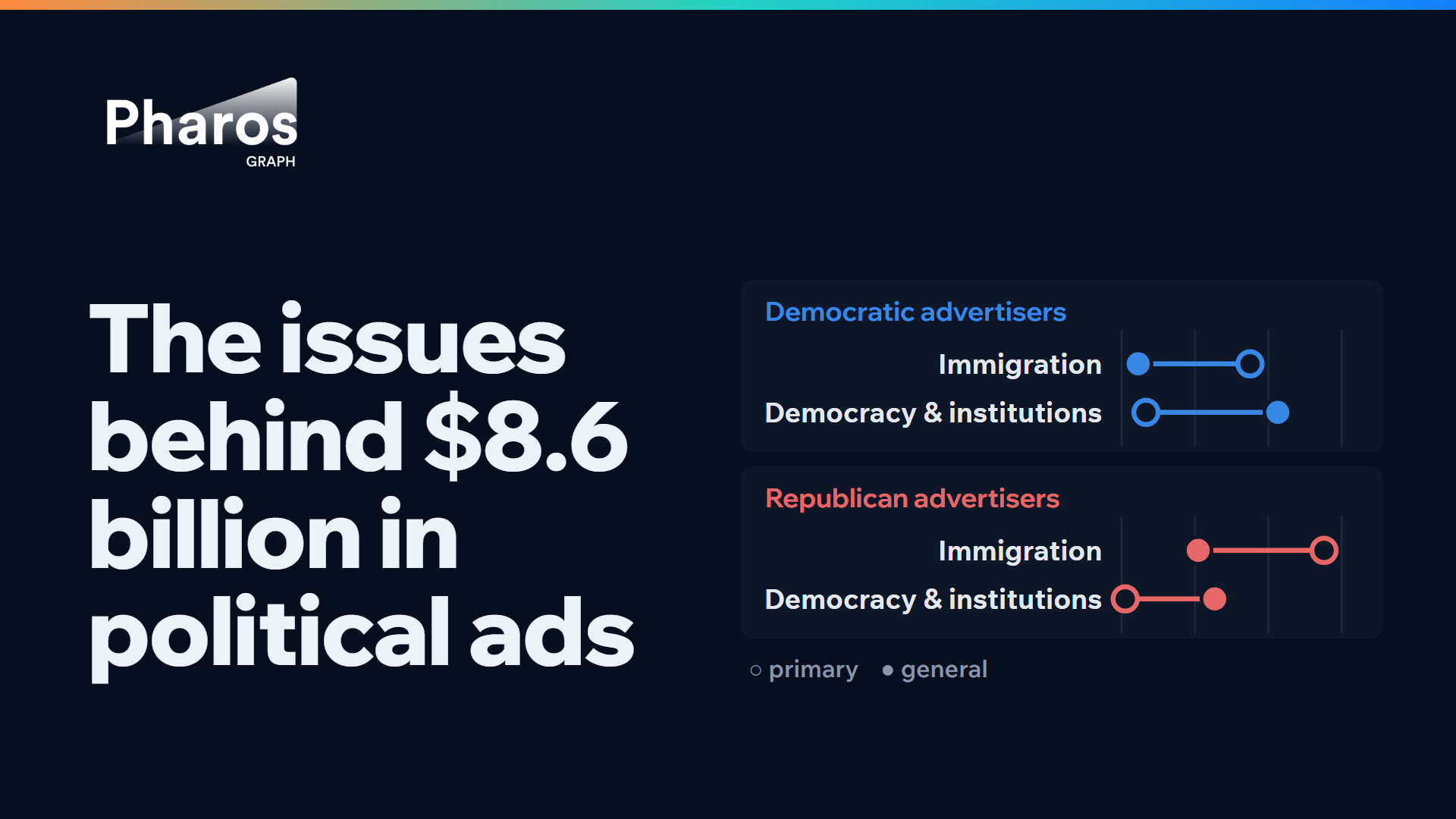
The issues of cost of living, candidate character and taxes drew the most money in this cycle’s $8.6 billion in political ads, and through the fall they held a steady share at the top. However, the issues below them moved. Right after the primaries, both parties cut the share of their ads on immigration. By late October, the share going to ads about democracy and institutions had nearly tripled since early September.
AdImpact tracked political ads from October 2025 to Election Day, and PharosGraph’s AdScape™ analyzed each one to identify the issues it covered. Issue dollars divide each ad’s dollars among those issues: an ad about one issue counts in full toward that issue, and an ad about three issues splits its dollars three ways. Ads that cover no policy issue, about 9% of the money, are left out.
Both parties changed their issues right after the primaries
Once a race’s primary was over, both parties turned their ads to the general election. In statewide races, the share of Democratic issue dollars spent on immigration ads went from 11% the week before the primary to 1% the week after. The Republican share went from 15% to 3%.
The shift didn’t come from a shake-up in who was advertising. Advertisers who ran ads in both the primary and the general carried 75% of Democratic and 71% of Republican dollars, and they changed their issues about as much as everyone else.
Democrats cut their spending on immigration ads from $81M in the primaries to $29M in the general. Republicans spent a little more on immigration in the general, $166M against $144M, but their overall spending grew much faster, so immigration fell from 17% of their issue dollars to 6%. Even the cycle’s biggest week for immigration ads, $42M in the last week of October and mostly Republican money, was only about 4% of that week’s issue dollars, against about 13% from January to June.
For most races, the primary was a poor preview of the general, even with the same advertisers on air. The switch showed up the week after the primary, which makes that week the first clear read of the other side’s general-election message. Watch its issue mix that week, rather than planning against what it ran in the primary.
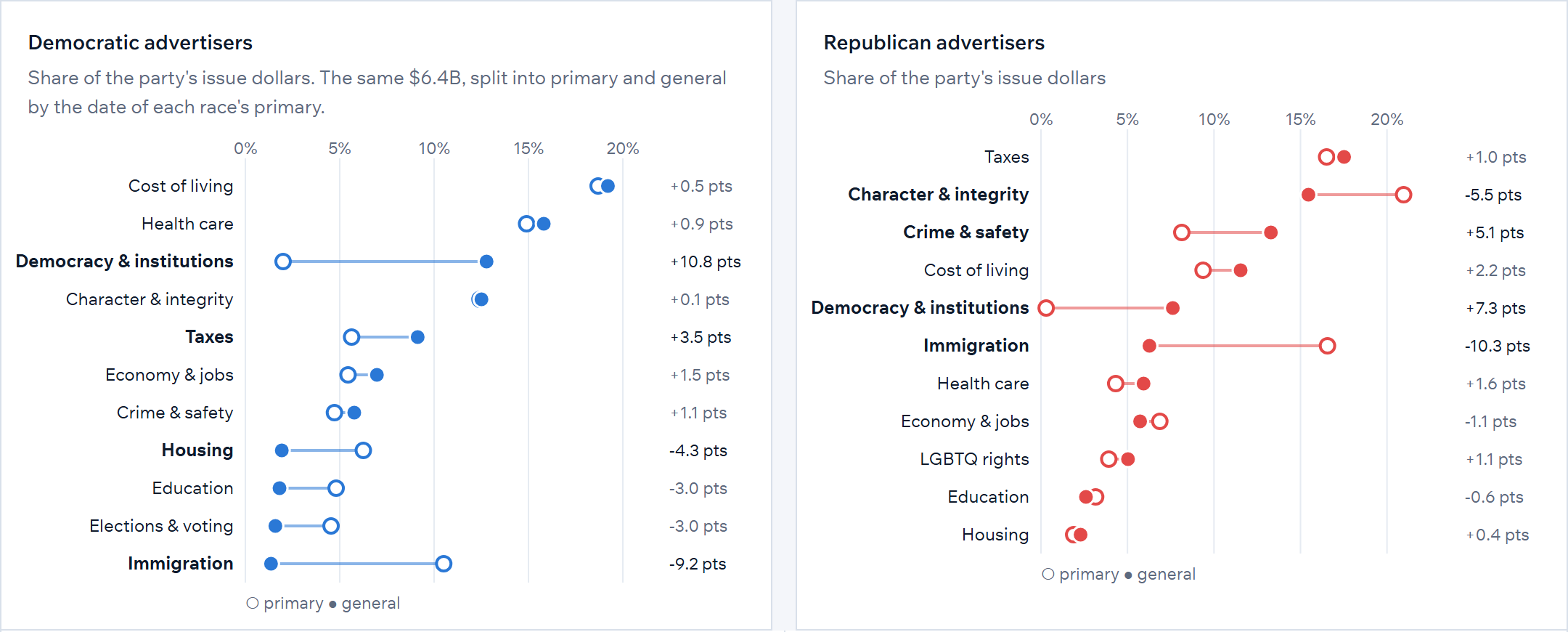
Primary and general are split race by race on each race’s primary date.
The mix of issues kept moving through the fall
Most of the money, $5.14B of the $8.59B, went to 2026 general-election races. The three leading issues took about 41% of issue dollars in both September and October. The movement came underneath them. Ads about democracy and institutions went from 4% of weekly issue dollars in the week of September 1 to 11% in the last week of October.
Before each buy, check the current weekly mix of issues and look for the ones with less money behind them.
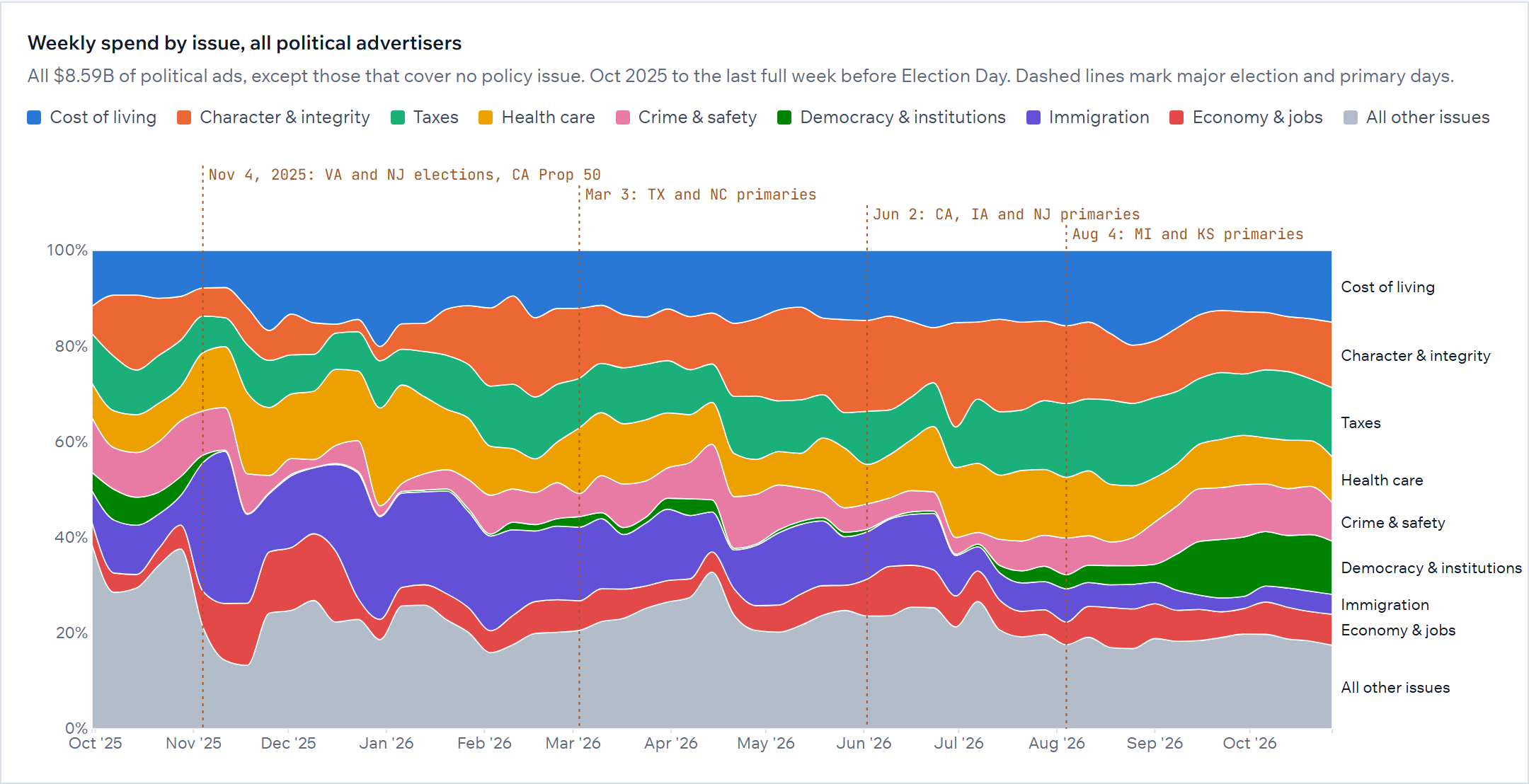
PharosGraph reads each ad’s transcript and identifies the issues it covers.
Neither party owned cost of living
Cost of living was one of the two biggest issues. An issue counts as owned when one party outspends the other on it by more than 2 to 1 in candidate races. Republicans owned the issues of taxes, crime, immigration, LGBTQ rights and veterans. Democrats owned the issues of health care, energy and climate, foreign policy and abortion.
In the general election, just 17% of Democratic issue dollars in candidate races went to Republican-owned issues, and 9% of Republican issue dollars went to Democratic-owned ones.
The real contest was over cost of living. Both parties spent heavily on it in candidate races, Democrats $549M and Republicans $387M. On the owned issues the gap was at least 2 to 1, so a campaign that crosses into the other party’s issues is likely to be outspent there. Cross that line only on purpose, and look early for the big issues neither party owns. In 2026, that’s where both sides met.
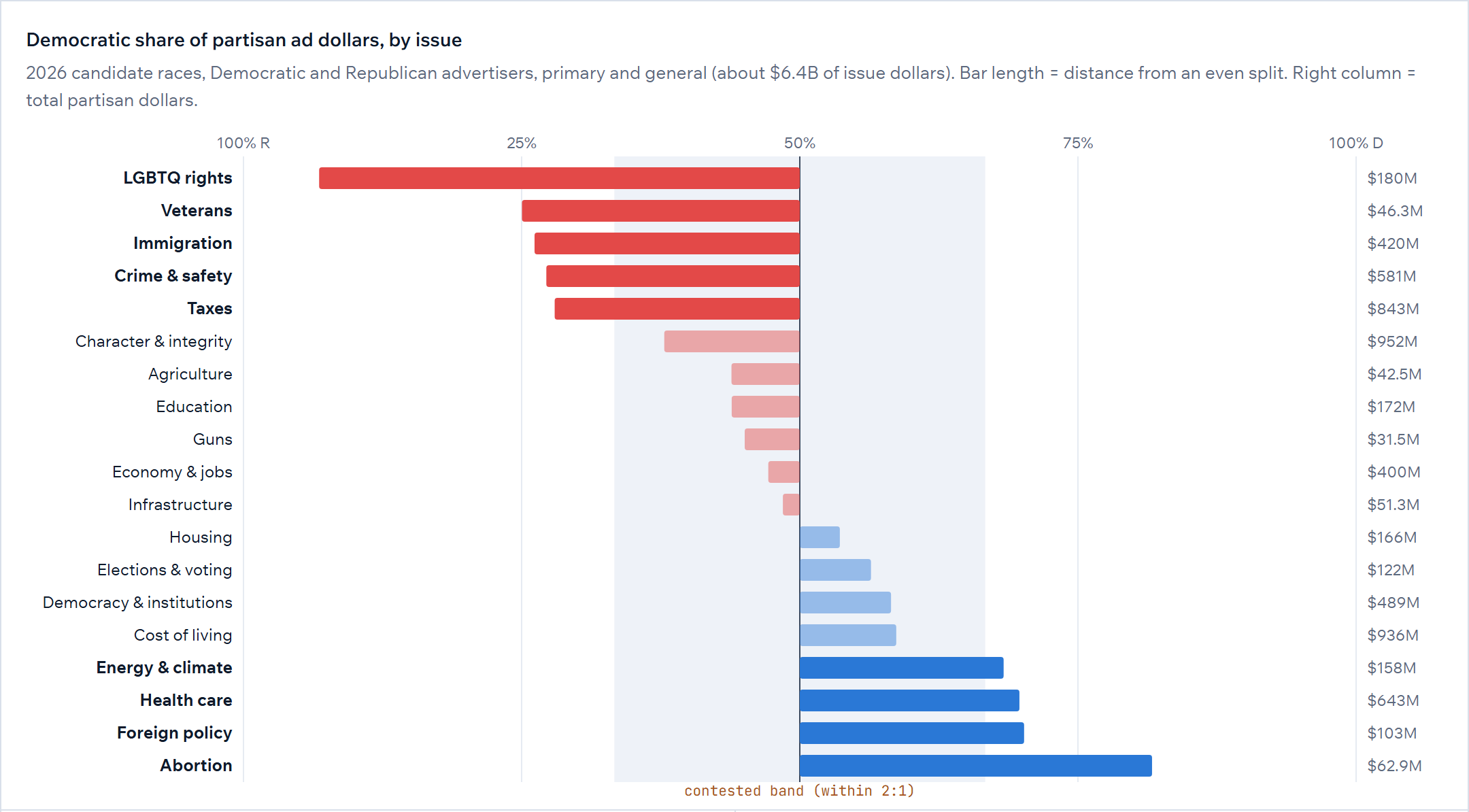
Party is the advertiser’s party in AdImpact’s data.
The national mix of issues hid large state differences
National figures can be a poor guide to a single state. In North Carolina, Nevada and Texas, ads on the issue of crime and safety took about twice their national share of issue dollars, and in Maine, health care ads did the same.
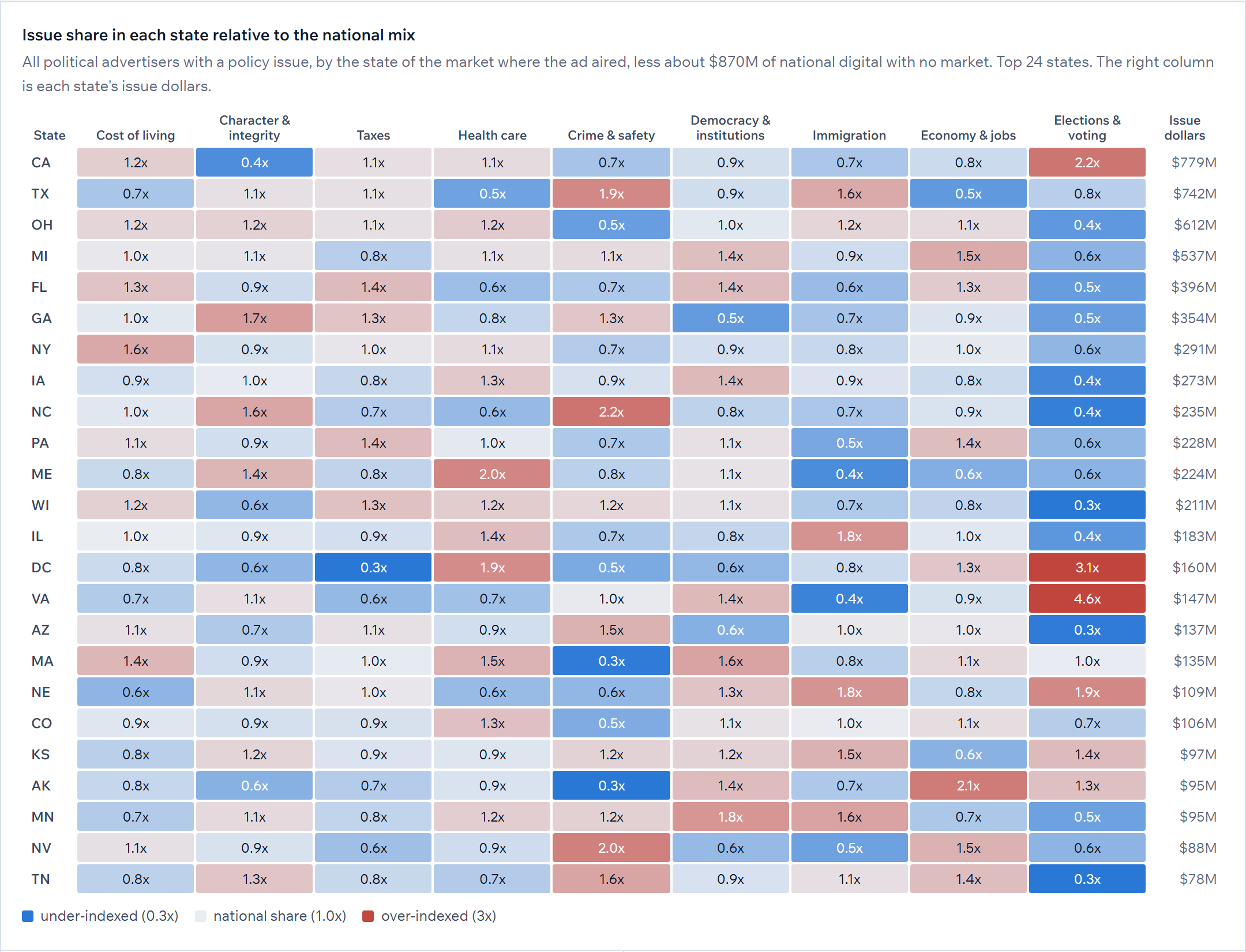
Each cell is the issue’s share of the state’s issue dollars divided by its national share.
All four charts are on the Flight Log companion page.
For these readings and more on a race you supported in 2026, or one you’re planning for 2027 and beyond, write to info@pharosgraph.com.
How we measured it
- Spend is AdImpact placements from October 1, 2025 to November 3, 2026: $8.59B across broadcast, cable and digital.
- Runoffs count as primary, and in top-two states the first round counts as primary.
- Ads with no policy issue are left out of the issue figures. Independent advertisers are left out of the party comparisons, and about $870M of national digital with no market is left out of the state figures. In November 2025, 41% of the issue dollars spent on immigration ads came from a federal Department of Homeland Security campaign.
- These figures describe where the money went. Nothing here claims an ad moved a vote.
- The full method is on the Flight Log methods page.