Corporate Narrative Intelligence
You have the headlines. You're missing what's forming beneath them.
Monitor how narratives around your company, competitors, and industry evolve over time. Detect emerging risks and opportunities before they impact markets or reputation.
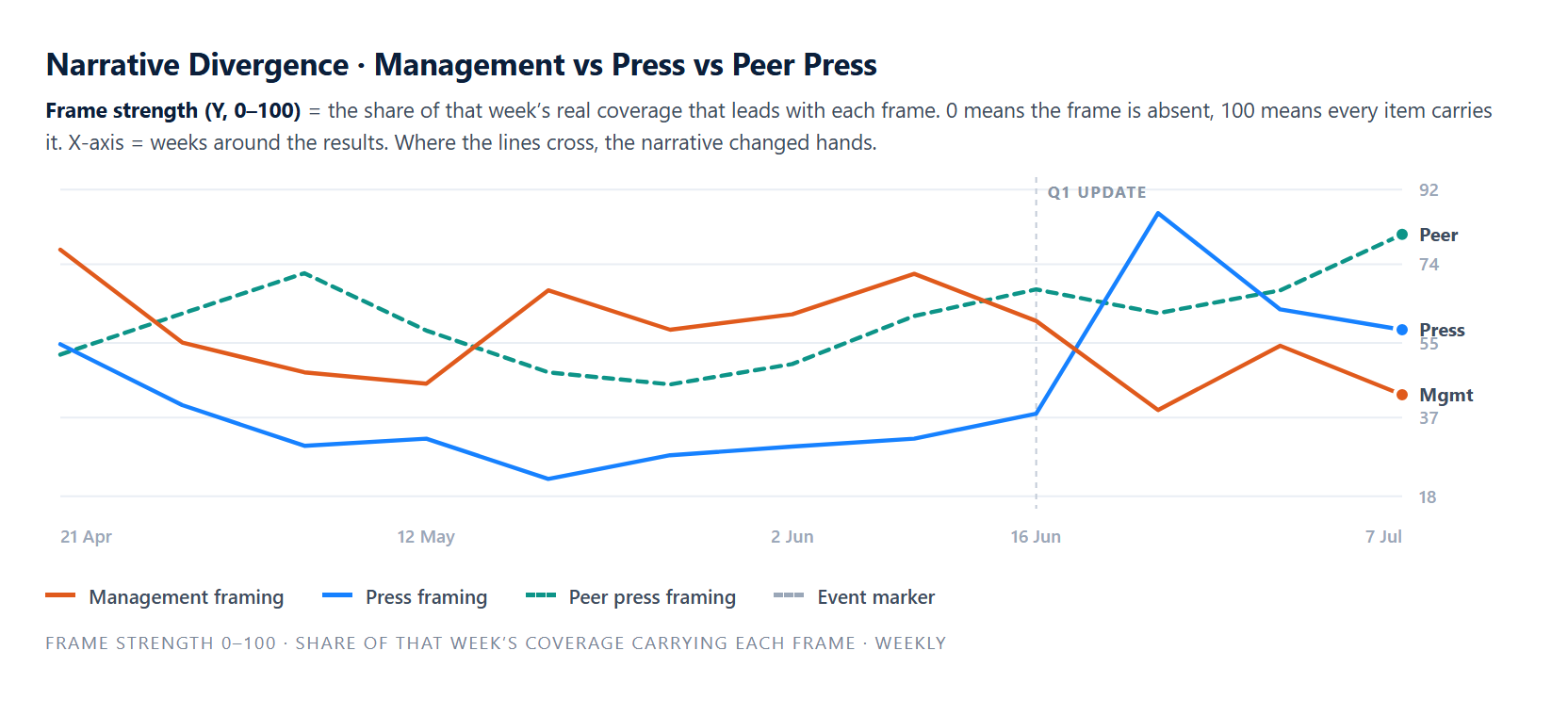
Company X FY26 · Narrative Divergence
The Science · The Tensor
Narratives are not flat. They are read differently by every stakeholder, on every horizon.
Traditional sentiment reduces a story to a single score, one reader, one moment. Pharos models how the same narrative is interpreted across stakeholders, time horizons, and signal types. The latent structure beneath what markets actually price.
One score. One story. One reader.
A single polarity number, averaged across whatever was published. Useful for trend lines, useless for action. Tells you the temperature, not what’s actually moving or who’s moving it.
Multidimensional. Stakeholder-aware. Time-resolved.
Every narrative is decomposed across three axes: who’s interpreting it, on what horizon, and what type of signal it carries. The output is a structured read on where the conversation actually is, not a number averaged from where it has been.
The IR Workflow
One lens, applied twice. Before the call to prepare. After the call to learn.
Two connected modules of the same underlying tensor. One readies the room before management steps on stage. The other closes the loop on how the story actually moved, so the next quarter starts with sharper inputs, not the same blind spots.
Before the Call
Walk into the call knowing who is in the room, what they’re likely to ask, where the narrative has drifted from your intended message, and which executive each question should route to.
- Predicted analyst attendance & questioning roster
- Questioning DNA per analyst: skepticism, specificity, follow-up rate
- CEO ↔ CFO routing: which exec answers which question better
- Likely pressure themes, ranked by probability
- Relationship drift signals: strengthening and declining
- Peer benchmarking: how your narrative ranks in category
After the Call
Watch how the story actually moves in the days that follow. Which themes landed, which got reframed, how analyst stance shifted, and where the press contradicts what management said.
- Press interpretation, theme by theme
- Management vs. press divergence, scored daily
- Contradiction detection: what the press is pushing back on
- Credibility & novelty shifts vs. prior quarter
- Contagion across peers: what’s spreading and where
- Stakeholder-aware interpretation, not aggregate sentiment
What “Moved” Actually Looks Like
Three narratives, one lens.
Scored, compared, and ranked.
Management framing. Press framing. Peer-press framing. Three voices on the same earnings story, tracked from the moment the call ends through the days that follow.
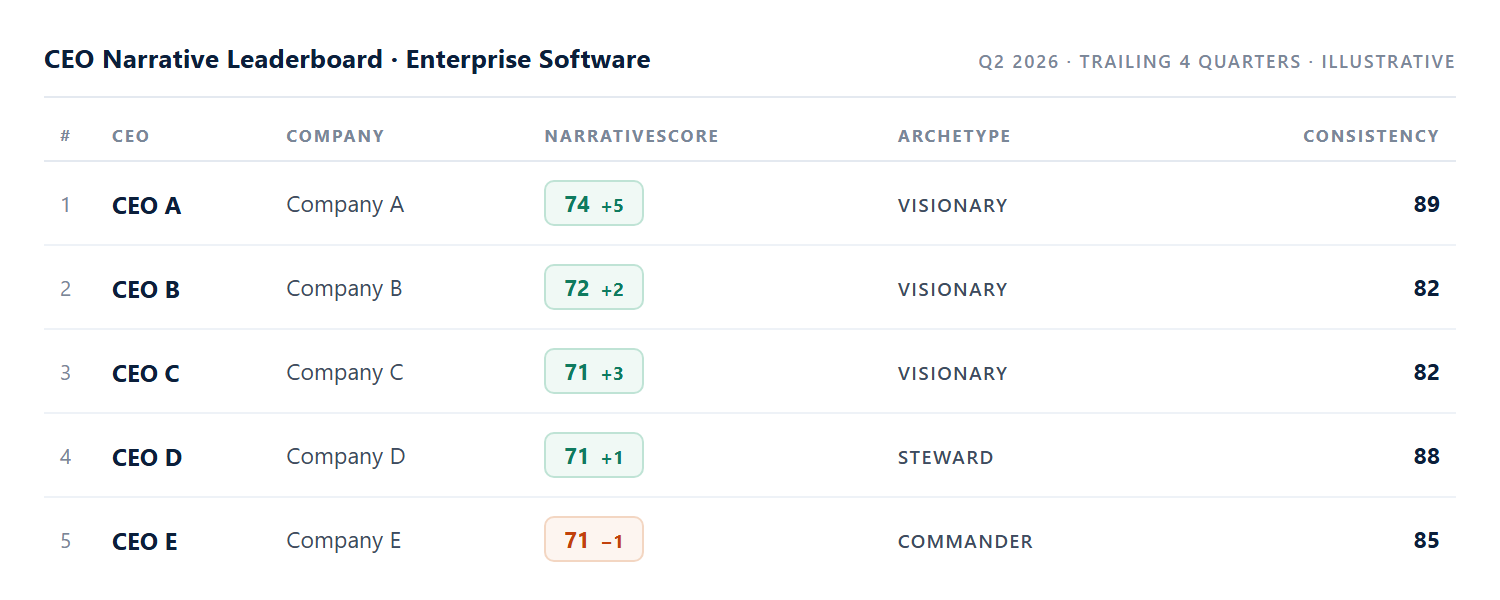
Ranked across a sector. NarrativeScore is how clearly management’s intended story is landing with sell-side and press. Archetype is the narrative posture that dominates. Consistency is how much stakeholders agree on what the company stands for.
Enterprise Software · CEO Narrative Leaderboard
The score
How clearly the intended story is landing with the people who retell it, with the movement since last quarter.
The posture
Visionary, Steward, Commander. The archetype a company is actually read as, which is not always the one it is aiming for.
The agreement
Consistency is the cross-stakeholder read. A high score with low consistency means the story is loud and contested.
Investor Relations
Three voices on the same quarter,
pulling apart by the day.
The same engine, pointed at the earnings call and the weeks around it. Management framing, press framing, and peer-press framing, tracked from the moment the call ends. This is the picture the transcript cannot give you: the results were delivered once, and then they were retold three different ways.
Why This Is Different
Conventional IR tools count what already happened. Pharos explains what’s moving, where, and what to do about it.
Sentiment averages noise. The tensor reads structure.
One number averaged across whatever was published tells you the weather, not the system underneath it. We model who is reading the story, on what horizon, and with what kind of signal, so you can act on the divergence, not just track it.
Monitoring is a feed. This is a read.
Clip alerts and PR dashboards tell you what was published. Pharos tells you how the narrative moved. Which themes the press reinforced, which it reframed, where it contradicted management, and what’s spreading across the peer set.
Prep memos rely on memory. We score every call.
Most IR teams prepare by re-reading last quarter’s transcript and guessing who’ll be on. We score every analyst across every S&P 500 call they touch. You get the questioning DNA, not the vibe.
See the Engine in Action
Bring us a company,
an industry, a narrative.
We will show you what is taking hold, where it is concentrated, and how fast it is moving.