
A New Frontier in Campaign Intelligence
The battleground of public opinion has shifted. Increasingly, voters—especially younger, more affluent ones—start their political research not with newspapers or debate clips, but by asking ChatGPT. They’re turning to Large Language Models (LLMs) not just to get informed, but to get oriented: Who is this candidate, really? What do they stand for? And why should I care?
LLMs like ChatGPT are fast becoming default decision-support tools for high-intent voters (and shoppers). And these models are not neutral. They reflect and amplify the stories, values and frames circulating in public discourse. That means campaigns can no longer afford to focus solely on traditional media monitoring or polling. They need to understand how they are being interpreted by AI.
PharosGraph’s Narrative Engine Optimization (NEO) platform provides precisely this visibility. In the context of the 2025 Colorado gubernatorial primary, our tools offer a high-resolution map of how candidates ranging from leading Democrats to underdog Republicans are framed across LLMs and narrative ecosystems. What emerges isn’t just a picture of where each candidate stands, but how they are understood.
Why Narrative Intelligence Matters in 2025
Traditional campaign analytics focus on “what” voters believe. Narrative intelligence uncovers the “why” behind those mindsets. Are you the hero in the story? The villain? The victim?
The chart below shows how selected leading candidates and challengers are framed by LLMs today with Phil Weiser largely cast as a “hero,” while Republican Greg Lopez has very little hero framing. On the other end, Barbara Kirkmeyer is the most likely to be framed by LLMs as a “villain.”
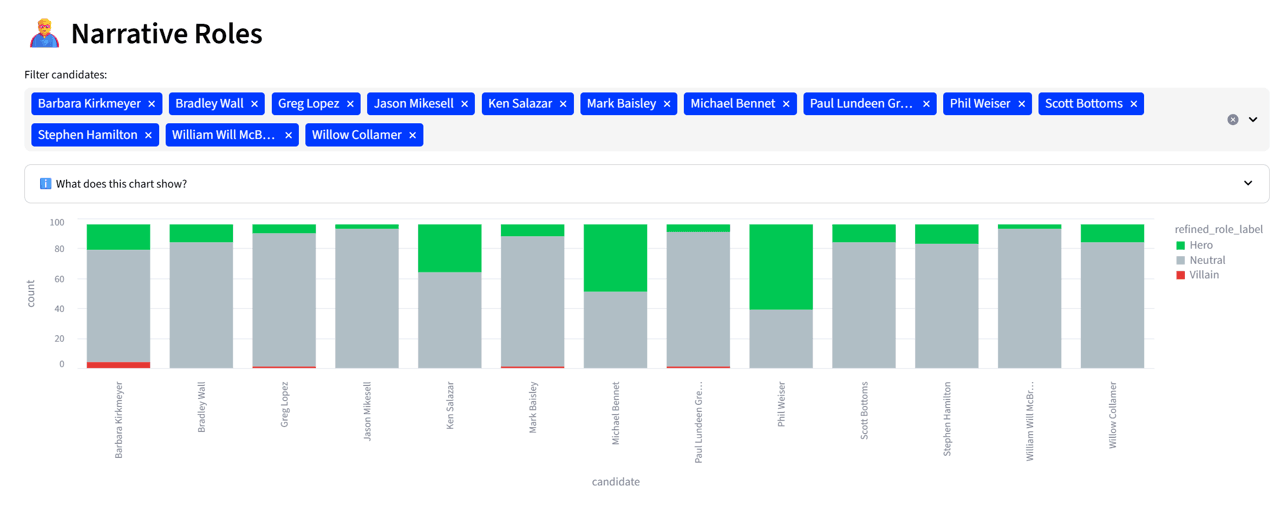
It’s important to note that LLMs aren’t simply parroting back headlines; they synthesize meaning. They create digestible reputational narratives that many voters use as shorthand for candidate identity. The stakes here are enormous: candidates who fail to shape these ambient perceptions risk ceding narrative territory to opponents and outside media forces.
This shift represents a fundamental change in campaign strategy: broad polling and generalized sentiment tracking are no longer sufficient. Narrative intelligence acts like a scalpel—allowing campaigns to precisely identify how a candidate is perceived, where those perceptions are gaining traction, and what values or archetypes they are most closely associated with. It enables a deeper, more surgical approach to voter understanding in an age when reputations are shaped algorithmically and at scale.
The LLM Perspective: Framing the Republican Field
Greg Lopez: Third Time’s the Charm?
Greg Lopez has emerged as one of the most prominent Republican candidates in the statewide narrative landscape. A familiar face in Colorado politics and a two-time previous contender in Republican gubernatorial primaries, his narrative tags show recurring associations with themes like economic freedom, family values and business leadership. In many precincts, he holds not only name recognition but favorable moral positioning.
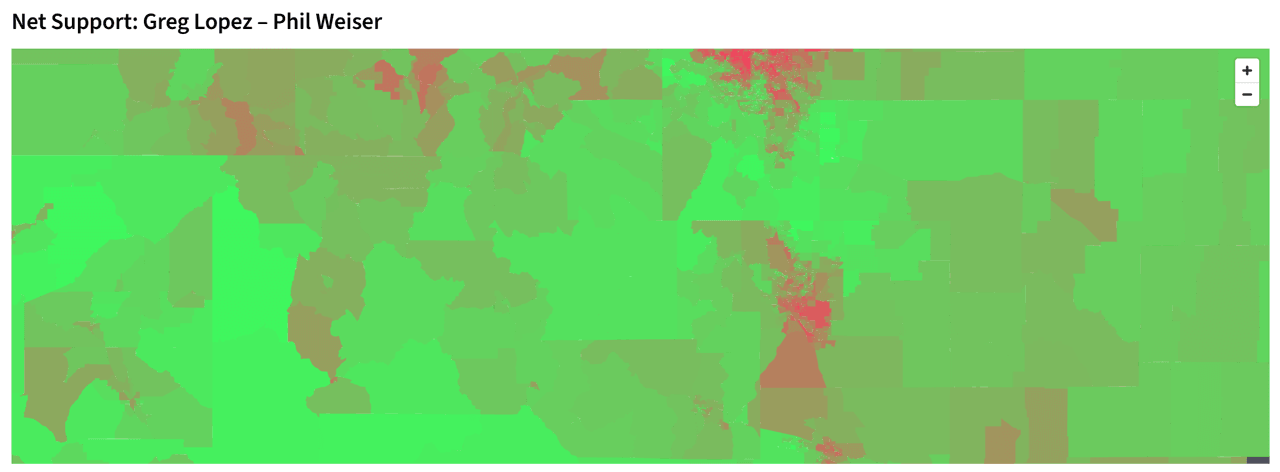
However, the polarity of framing is not universally positive. In moderate precincts, Lopez faces increasing narrative drag tied to perceived alignment with hard-right populism. The map above shows precincts in red where Lopez trails Democrat Phil Weiser with many of these precincts concentrated in voter-rich Denver. These early signs suggest that unless managed, Lopez faces an uphill battle should he win the primary, but also opens himself up to challengers who may be viewed as more electable.
Barbara Kirkmeyer: The Conservative Stabilizer
Kirkmeyer enters the race with strong rural appeal and is often framed as a traditionalist grounded in community values. Her narrative word cloud reveals she is positioned as a pragmatic, local advocate who wants reform.
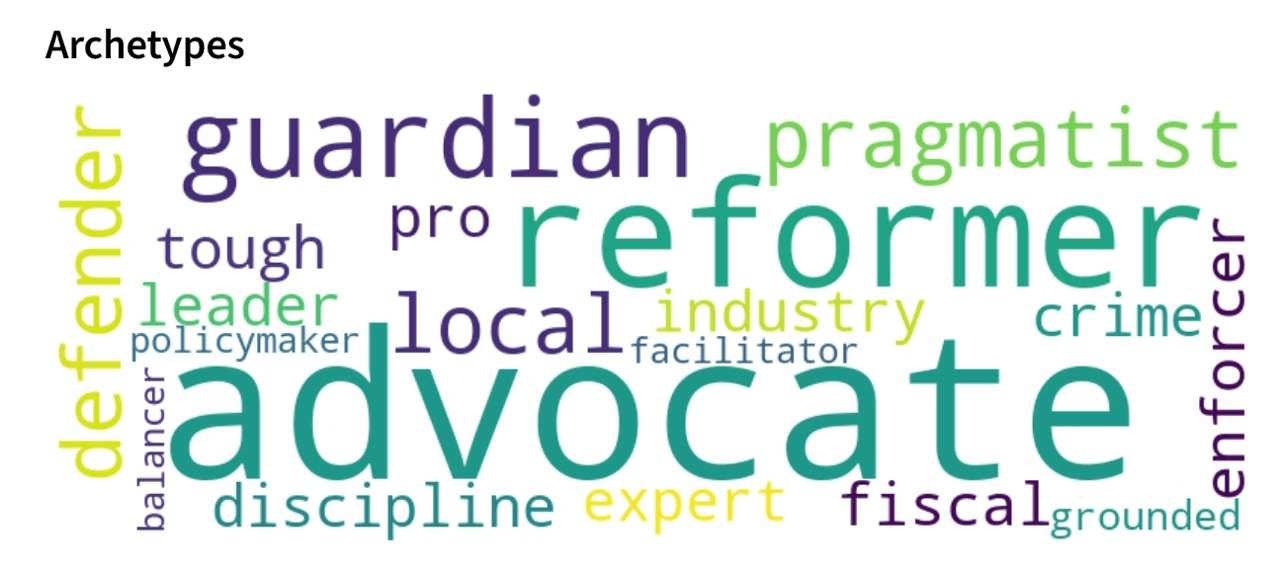
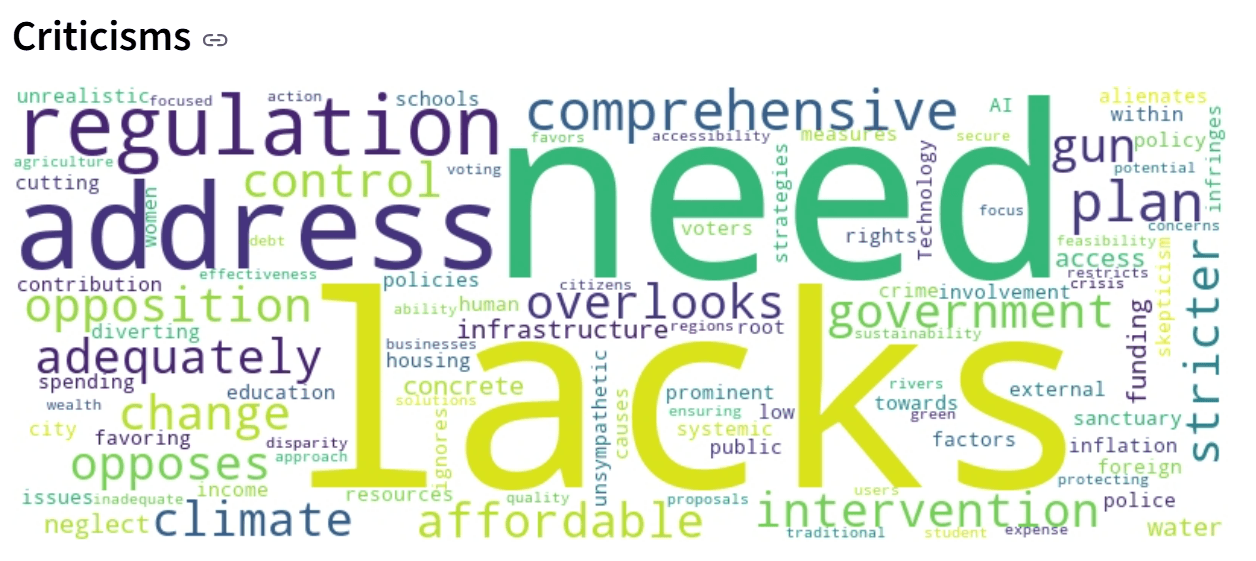
While her “family first” values and pragmatic conservatism dominate in rural communities, she will need to connect with more suburban and swing regions to win. She could start by addressing topics most commonly used by LLMs in her critiques, such as those shown below.
Mark Baisley: The Constitutional Firebrand
Baisley differentiates himself through moral language centered on liberty, constitutional order and anti-government sentiment. Among ideological conservatives, he shows strong contrastive framing—emphasizing his role as the ideological purist.
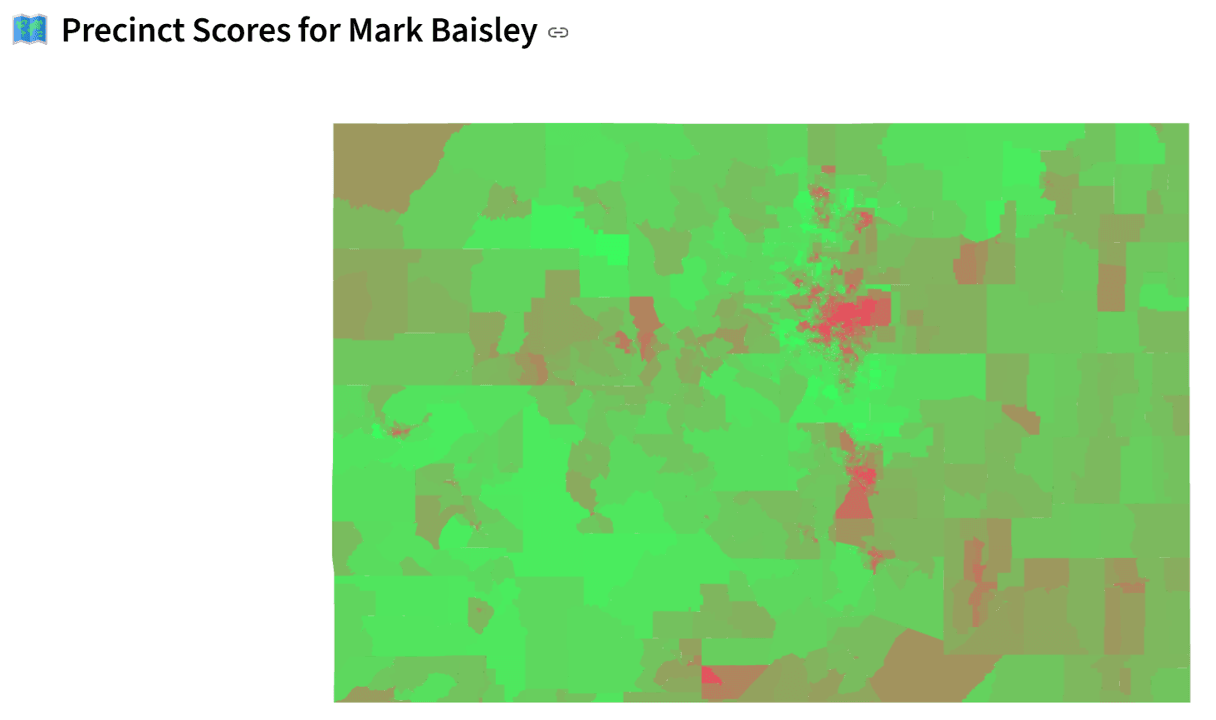
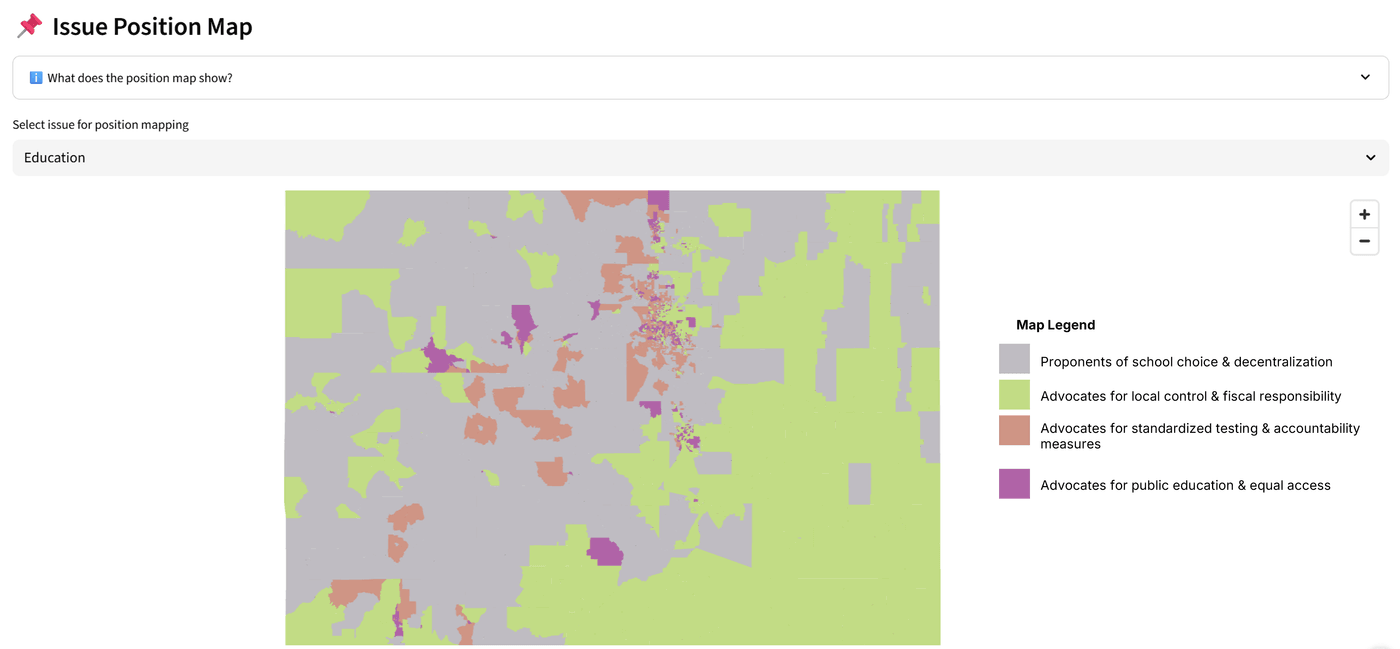
This contrast is both an asset and a liability. While he performs well in precincts concerned about government overreach, he struggles where voters seek even the slightest compromise.
Compare the two maps below, for instance. The first shows precincts where Baisley has his strongest support in green. The second shows counties clustered by their views towards education, one of Baisley’s top priorities. He performs best in the grey colored zones in the education map where voters are proponents of school choice and decentralization. But his support wanes even in the green zones where voters just want local control and fiscal responsibility. His challenge over the coming months is to convert narrative purity into coalition-building with like-minded voters.
Beyond Polls: What the AI Sees (and Why It Matters)
LLMs process massive quantities of news, social content, policy documents and campaign materials. What they return isn’t random; it’s distilled reputation. For high-information voters using ChatGPT to “get up to speed,” these synthesized insights form the first impression—and often a lasting one.
Ignoring these frames means letting an uncontrolled narrative shape voter behavior. Understanding them means influencing how people talk, think and vote.
Strategic Implications: Frontrunners and Challengers
For Frontrunners like Lopez:
- Reinforce positive moral framing in precincts where LLMs show strong narrative resonance.
- Anticipate where opposition narratives are likely to break through
- Monitor framing polarity in swing areas to prevent narrative erosion
For Challengers like Kirkmeyer and Baisley:
- Use LLM-driven insights to find narrative gaps Lopez doesn’t occupy
- Strengthen precinct-level issue alignment to increase narrative salience
- Recast weaknesses (e.g., lack of name ID) as differentiators in emerging themes
Conclusion: Owning the Narrative is Owning the Race
In 2025 and beyond, candidates are not just competing for votes. They are competing for narrative control. And increasingly, that means understanding how AI frames their story.
Campaigns that treat narrative intelligence as a strategic asset will have the upper hand—not just in messaging, but in voter perception, precinct strategy and reputation defense.
Why PharosGraph NEO, Why Now
As the digital landscape shifts from search engines to AI assistants, traditional SEO alone no longer guarantees visibility. PharosGraph Narrative Engine Optimization (NEO) is the answer to this transformation. It helps ensure your story, expertise, or brand is not just searchable but actually cited and trusted by Large Language Models like ChatGPT and Gemini. By focusing on narrative clarity, credibility, and contextual depth, NEO positions you where it matters most: inside the answers of the tools people now rely on to learn, decide, and act.
Want to see how your campaign is being framed by the tools voters trust most?
PharosGraph offers real-time narrative intelligence to help campaigns identify their strengths, vulnerabilities and strategic opportunities in an AI-driven landscape.
Request a demo today and take control of your campaign’s story—before someone else writes it for you.