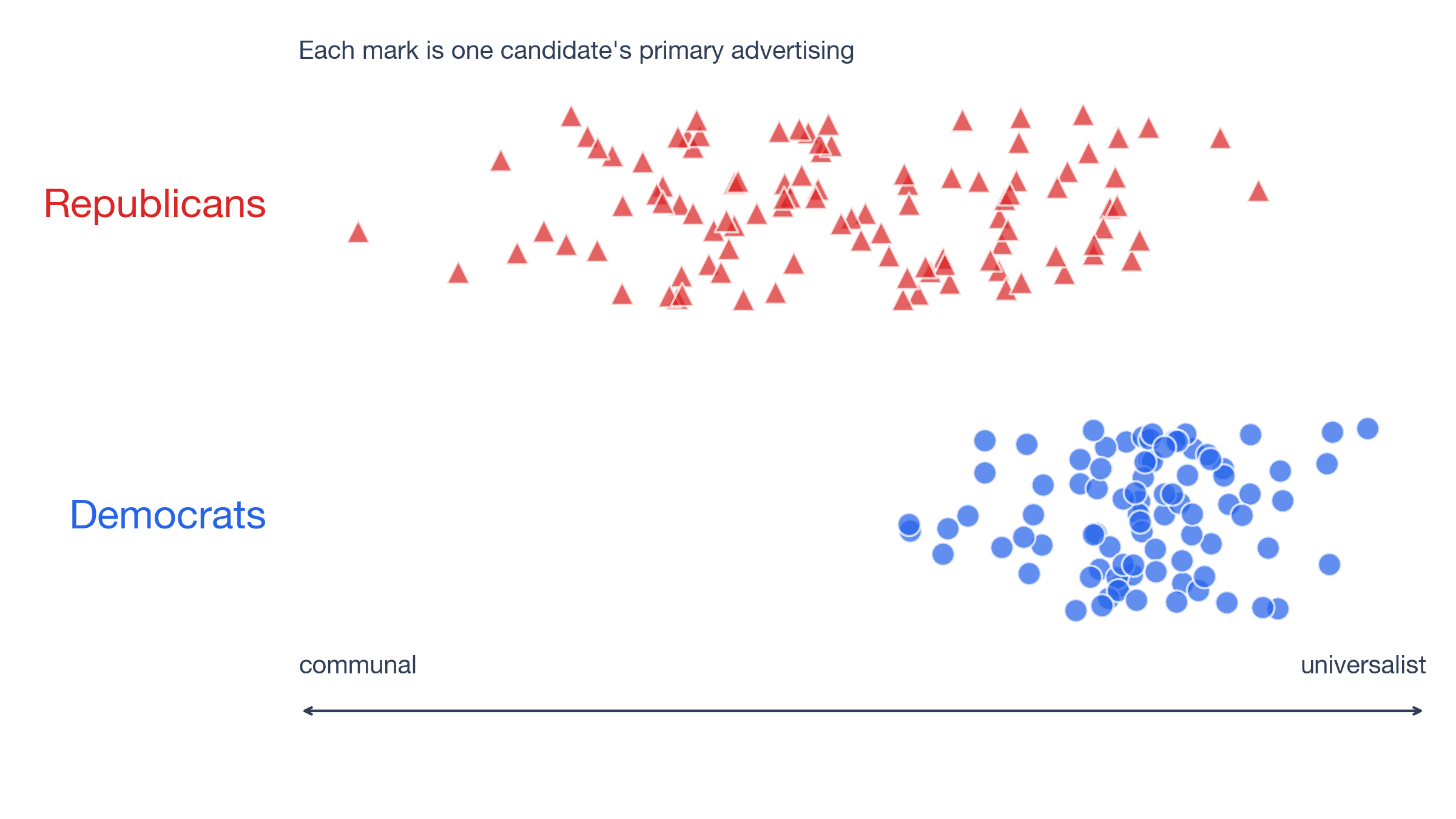
The figures cover advertising through the week ending August 31, 2026. Seven races, in Massachusetts, New Hampshire, Rhode Island and Delaware, hold their primaries after that cutoff and are therefore measured one to three weeks short of their own primary. Those races are already about 91 percent observed on their own spending, so the advertising still to air in them is about 0.4 percent of this frame.
Two Republicans running in different states can make completely different moral arguments. Two Democrats make close to the same one. Andy Barr’s ads in Kentucky and Susan Collins’s ads in Maine argue from nearly opposite moral ground, yet both of them are Republicans. James Talarico in Texas and Xavier Becerra in California, both Democrats, argue from almost identical moral ground. Kentucky and Maine sit about as far apart politically as Texas and California do. Republican campaigns occupy a much wider range of moral positions than Democratic campaigns, and those positions vary systematically with the states where they are competing.
We analyze this pattern using the language of universalist and communal positioning. Universalist appeals ground arguments in care and fairness owed to people generally. Communal appeals ground arguments in loyalty, authority and sanctity owed to one’s own community, social order or nation. This distinction builds on research in moral psychology showing that people reason about right and wrong along multiple foundations, including care, fairness, loyalty, authority and sanctity (Graham, Haidt & Nosek, 2009; Haidt, 2012). A sixth foundation, liberty, meaning resistance to domination and constraint, is contested in that literature (Iyer, Koleva, Graham, Haidt and Ditto, 2012) and is reported here separately. Political communication can therefore differ not only in which issues it emphasizes, but in which moral foundations it invokes to justify those issues. Recent work in economics and political behavior further distinguishes between universalist and communal messaging, showing that the same policy can be framed in either moral register (Enke, 2020). We express the two on a single universalism index. Positive scores mean the advertising leans universalist, negative scores mean it leans communal, and every number in this piece is a position on that index. The 191 campaigns in this field run from about −4.6 to +3.1.
In this framework, “brand” refers only to a campaign’s position on this moral axis. It does not refer to a candidate’s complete identity, biography, issue portfolio or tone. Two campaigns can differ substantially in every other respect while occupying a similar position on this axis.
Measuring Moral Positioning
We scored candidate advertisements in the 2026 gubernatorial and Senate primaries according to the moral foundations invoked in their arguments. The analysis distinguishes between two broad poles:
Universalist positioning, which appeals to care and fairness owed to people generally.
Communal positioning, which appeals to loyalty, authority and sanctity within a particular community, social order or nation.
This is not an issue classification. Advertisements about immigration, taxation and public safety can all land in the same place on this axis, because what we score is how an advertisement argues rather than what it argues about. Two advertisements on the same issue can land far apart for the same reason.
The dataset includes 11,917 distinct advertisements aired approximately 8.8 million times between the week of September 30, 2025, and the week ending August 31, 2026, representing $667 million in primary advertising across 191 candidates, 68 races and 45 states. The advertising census comes from AdImpact; the moral-foundation scoring and analysis come from PharosGraph.
Mapping Moral Positioning: a Visual
The pattern is clearest in individual ads. The figure places four real campaign ads on the same universalism–communalism axis: among campaigns whose candidate spent more than $1 million in total, the most extreme voter-directed advertisement at each pole within each party. The AI score determined their positions.
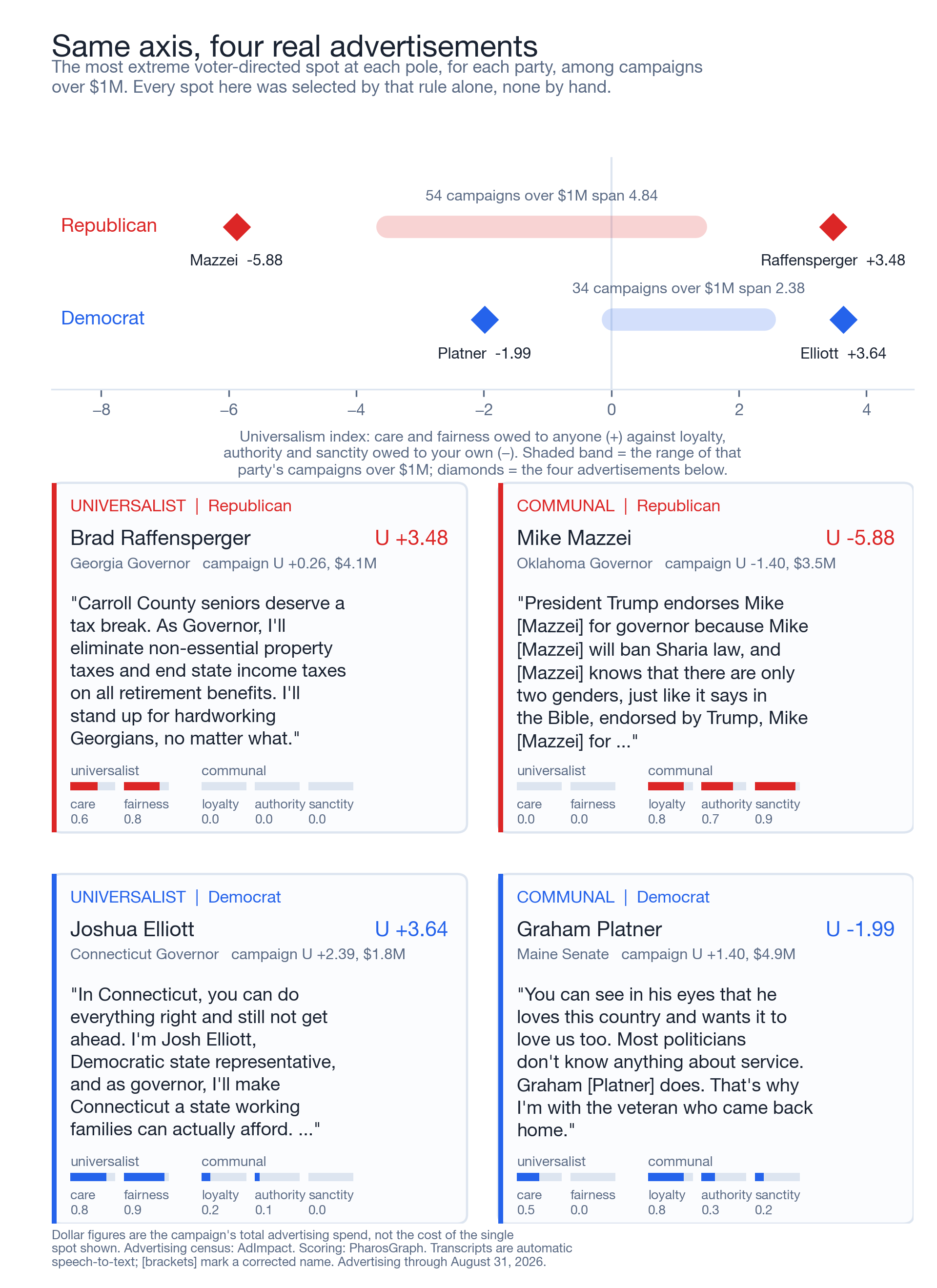
The result is revealing. Republican advertising spans a much wider range, from Brad Raffensperger’s universalist appeal to tax relief and equal treatment for Georgians to Mike Mazzei’s strongly communal appeal centered on religion, gender, and allegiance to Donald Trump. Democratic advertising occupies a narrower range, but it is not uniform: Joshua Elliott’s message emphasizes economic opportunity and working families, while Graham Platner’s stresses service and love of country. The spread is measurable. Among the 88 campaigns that spent over $1 million, Republicans span 4.84 points on this index against 2.38 for Democrats, about twice as wide. Across all 191 campaigns the shape is the same, 6.81 against 3.46. And the two poles are not equally available. Both parties reach the universalist end, their most universalist spots landing within two-tenths of a point of each other. Only Republicans reach the communal end: the most communal Democratic advertisement that clears the same filters sits at −1.99, the Republican one at −5.88.
The point is not that every Republican or Democrat speaks in one moral voice. It is that the same axis makes the parties’ internal structures visible: Republican campaigns operate as a portfolio of differentiated moral brands, whereas Democratic campaigns cluster more closely around a shared moral territory.
Two distinct partisan products
When candidates are ordered by party, the distributions barely overlap. Only three of 104 Republican campaigns score above the median Democratic campaign, and all three spent less than $1 million. Democrats emphasize care and fairness more than Republicans do, and Republicans emphasize loyalty, authority and sanctity more than Democrats do. Each foundation splits the way the theory predicts. Neither party uses more moral language than the other. They are emphasizing different moral foundations.
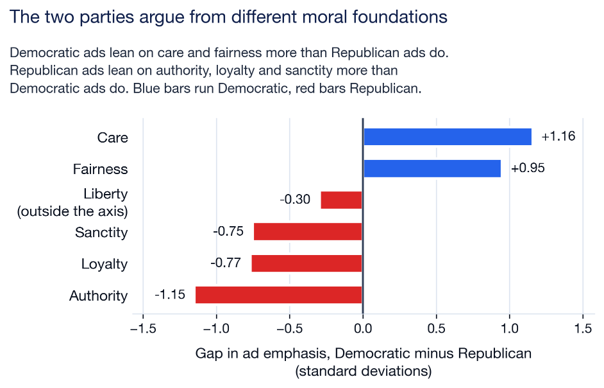
Each bar is the gap between the parties in how much their advertising emphasizes one foundation, measured in standard deviations. Bars running right are more Democratic, bars running left more Republican.
Democratic advertising is strongest on care and fairness. Republican advertising is strongest on authority, loyalty and sanctity. Liberty leans Republican but remains closest to neutral, making freedom language the least partisan moral appeal in the dataset. If the parties merely differed in the intensity of moral rhetoric, all foundations would point in the same direction. However, the data shows they do not, and reveals a difference in moral positioning, not merely a difference in rhetorical volume.
Republicans adapt across states, Democrats do not.
The central asymmetry appears when the analysis holds party constant and compares campaigns across states.
These comparisons are cross-sectional: different candidates in different states, each measured during their own primary. The longitudinal question, whether a given campaign moves its own position, is what the general-election read answers.
| Blue states (GOP under 50%) | Red states (GOP 55%+) | Range across states | |
|---|---|---|---|
| Republican campaigns | +0.22 | −1.45 | 1.66 sd |
| Democratic campaigns | +1.41 | +1.26 | 0.15 sd |
Republican campaigns therefore cover roughly eleven times as much moral ground across states as Democratic campaigns do. Those range figures are standard deviations on the universalism index.
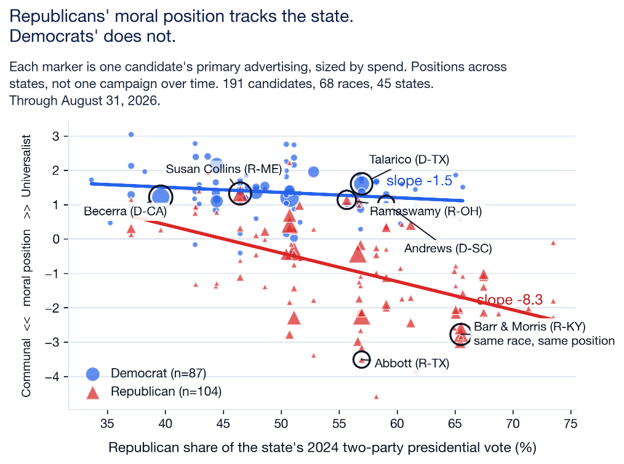
Republican moral positioning becomes more communal in red states and more universalist in blue states. Democratic positioning remains close to its national center across both environments.
The pattern is visible in individual races. Andy Barr and Nate Morris are Republicans running against each other in the Kentucky Senate primary, in a state that gave Trump 66 percent of the two-party vote. They score −2.78 and −2.59, on $17.7 million and $13.4 million of advertising: two rivals in one race, the same deep communal position. The state is setting it, not the opponent. Susan Collins, a Republican competing in Maine, scores +1.33 on $21.1 million, roughly four points away from the Kentucky candidates. In Texas, Ken Paxton scores −3.18 and Greg Abbott −3.51; Abbott is the most communal campaign in the field among those spending more than $1 million.
Democratic campaigns show much less variation across the same geography. James Talarico, running for Senate in Texas, scores +1.61; Xavier Becerra, running for governor in California, scores +1.22. Those two states are 17 points apart on the 2024 Republican vote and the two campaigns are 0.39 points apart. Susan Collins in Maine and Andy Barr in Kentucky are 19 points apart on the same measure and 4.10 points apart on this index. Rob Sand in Iowa scores +1.02, Jasmine Crockett in Texas +1.37 and Juliana Stratton in Illinois +1.10.
The concentration is substantial. Some 93.7 percent of Democratic advertising dollars fall within one point of the Democratic median, compared with 39.2 percent of Republican dollars within one point of the Republican median. Eighty percent of Democratic spending falls within a band 0.93 points wide, compared with 3.20 points for Republican spending. The limited variation among Democrats does not track state partisanship: the estimated Democratic gradient does not reach statistical significance (p = 0.13).
The pattern should not be overstated. State partisanship explains 26 percent of the variation in Republican positioning, not all of it. Vivek Ramaswamy in Ohio (+1.14) and Ashley Hinson in Iowa (+1.10) are examples of red-state Republicans using universalist positioning. The claim is not that Republicans operate a neat one-campaign-per-state system. It is that Republican campaigns are more dispersed around their party’s center, and that state partisanship explains a meaningful share of this dispersion. Republicans run many moral products rather than one per state, and a single communal bloc still carries roughly 40 percent of Republican spend.
Why the asymmetry exists
The intuitive explanation is that Republicans simply sell into a more variable market: their voters are spread across suburbs, small towns and rural areas, while Democratic voters concentrate in large metropolitan counties. That half is right. In the data, 84 percent of Democratic votes come from the largest fifth of counties, compared with 68 percent of Republican votes.
Geographic concentration, however, does not explain the moral-positioning gap. Using Enke’s published county-level index of universalist and communal values, which is built from survey responses rather than from ad copy, and weighting counties by the geography of each party’s votes, the two parties’ electorates vary across states by approximately the same amount. Both electorates shift with state partisanship at roughly the same rate. A Democrat in Texas faces a more communal electorate than a Democrat in Massachusetts by approximately the same margin as a Republican does. The political environment changes for both parties; only one party’s advertising changes comparably.
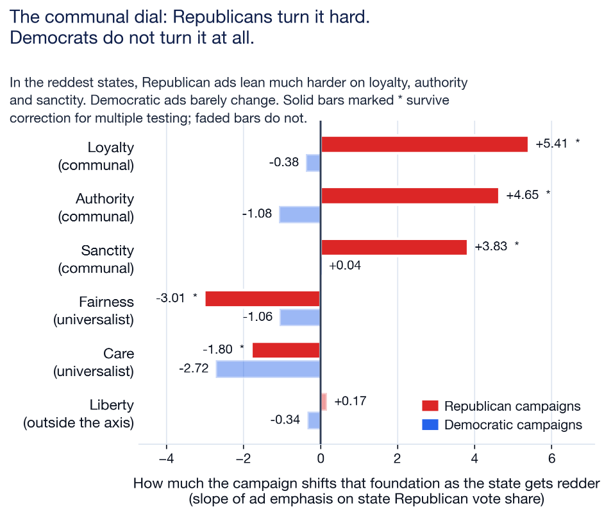
Each bar shows how strongly a party’s emphasis on one foundation tracks the state’s Republican vote share. Longer bars mean the appeal changes more from blue states to red ones.
The foundation-level results clarify how Republicans adapt. Loyalty, authority and sanctity (the communal foundations) vary strongly with state context, with all three relationships surviving correction for multiple testing at p = 0.003 or better. Republican appeals to fairness also vary (p = 0.003), but in the opposite direction and at roughly two-thirds the strength: the redder the state, the less a Republican campaign argues from fairness. Appeals to care run the same way as fairness, weaker again (p = 0.044). Among Democrats, no foundation-level relationship reaches the threshold for statistical significance; loyalty and sanctity are indistinguishable from zero.
The conceptual distinction is between indexed and general moral vocabulary. Loyalty, authority and sanctity are indexed: they refer to a particular community, social order or sacred object. When the geographic referent changes, the same words point at a different community, so the appeal shifts without the campaign contradicting anything it has said elsewhere. Care and fairness are general by construction. They express obligations owed to people as such. Localizing these appeals requires narrowing the category of people to whom the obligation applies, which changes the moral logic rather than simply adapting its expression.
The strategic trade-off
This distinction has an operational implication. Republican campaigns possess a moral vocabulary that can be localized across states, allowing greater fit with local electorates but requiring each campaign to construct more of its positioning independently. Democratic campaigns rely on a more stable national product, which supports coherence and production leverage but provides fewer obvious ways to adapt moral positioning where the local electorate differs from the party’s center.
| Localization available | Localization constrained | |
|---|---|---|
| Moral vocabulary | Loyalty, authority and sanctity; the referent can change across states | Care and fairness; the claim is general by construction |
| Strategic benefit | Greater fit with local electorates | Coherence, national consistency and production leverage |
| Strategic cost | Less positioning work is done by the national party brand | Potentially weaker fit in states such as Texas, Iowa and South Carolina |
| 2026 pattern | Republican campaigns adjust across five foundations | Democratic campaigns show no statistically significant foundation-level adjustment |
The analysis does not establish that Donald Trump causes the Republican gradient. Approximately one-third of the gradient is associated with alignment with Trump, whose value changes sign between red and blue states and is expressed in communal vocabulary. The majority is not. A further possibility, testable when third-quarter filings become available, is that Democratic campaigns rely more heavily on national small-dollar donors and may therefore be addressing a partly national audience across states. The current evidence identifies a constraint and an empirical pattern, not a definitive causal explanation.
Four implications for campaign strategy
Moral positioning should be measured explicitly. Campaigns track issue mix closely but often treat moral framing as an implicit by-product of copywriting. A candidate’s position relative to the party, opponent and state electorate can now be estimated from the advertising the campaign actually purchased.
Adaptation has a measurable cost. Localization may improve fit with the state electorate, but it can reduce national coherence and production leverage. The Republican data provide an empirical estimate of the scale of that trade-off.
Consistency also has a cost. Democratic campaigns gain a coherent national product, but campaigns in states such as Texas, Iowa and South Carolina may sacrifice local fit. The relevant question is no longer whether such a trade-off exists, but how consequential it is for electoral performance. That number does not exist yet, here or anywhere: this analysis carries no electoral-performance estimate, and until votes are counted nobody honestly has one.
Moral positioning can become a longitudinal metric. Rather than relying on anecdotes or a few memorable advertisements, analysts can benchmark candidates, opponents, states, parties and time periods using a common score derived from paid media.
What comes next: AI Scrutiny of the Midterms
The primary season offers a useful baseline: candidates are speaking mainly to committed partisan audiences. The general election creates a different test. Candidates must appeal to a broader, less ideologically uniform electorate, without losing the supporters who carried them through the primary.
Following the same campaigns through November will reveal whether their moral brands travel. Do candidates broaden universal appeals such as fairness and economic opportunity? Do they soften more communal appeals rooted in group loyalty, tradition, religion, or local identity? Or do they hold their positions?
The answers will clarify not only whether campaigns reposition, but also how repositioning works: which moral themes change first, how far candidates move, whether the shifts differ by party or race, and when they occur in the electoral calendar.
That is the next test of the “fifty brands versus one” argument: whether the moral distinctions forged in primaries endure, converge, or become newly differentiated when every candidate must compete for the broader electorate. The scoring runs continuously until then.
Method, briefly
This is what becomes possible when a complete advertising census is treated not only as media-spend data, but as a longitudinal record of how campaigns position themselves.
Data. AdImpact’s advertising census: every candidate spot, what it cost, where it ran, when. Broadcast, addressable, digital and cable. Channel shares are PharosGraph’s computation from those placement records rather than an AdImpact-published statistic: across the 186 candidates in this frame that carry channel-level detail, covering $458.1M of placements, the mix runs 53.8 percent broadcast, 35.0 percent addressable, 10.8 percent digital and 0.4 percent cable. That is worth its own article, because an analysis built on broadcast alone would miss nearly half of the air war.
Scoring. PharosGraph scores each advertisement with a large-language-model instrument, on six moral foundations: care, fairness, loyalty, authority, sanctity and liberty. The first five contribute to the universalist–communal axis. Liberty is analyzed separately because it is the contested sixth foundation (Iyer et al. 2012) rather than one of the canonical five; in this field it also sits close to neutral between the parties. Candidate positions are aggregated and weighted by advertising spend, measuring the moral positioning campaigns paid to place before voters. The instrument is validated externally: the two parties separate by 2.26 standard deviations on this axis.
The four advertisements. The four advertisements were selected according to a predefined rule: candidate-sponsored, voter-directed spots from campaigns spending more than $1 million; aired on or before the candidate’s primary; with transcript length inside the interdecile range; excluding attack-led advertisements that quote opponents and fundraising solicitations addressed to donors. Within each party, the highest- and lowest-scoring advertisements were selected. Transcripts are automatic speech-to-text, with corrected names shown in brackets where necessary. The Democratic communal example comes from Graham Platner’s Maine campaign; it aired March 17, 2026, before the June 9 primary he went on to win. He withdrew in July and the Maine Democratic Party named a replacement nominee, both after the measurement window for that race closes.
Scope. The dataset covers 68 races, 45 states and 191 candidates (118 gubernatorial and 73 Senate candidates) across approximately 4,000 candidate-weeks. Republican campaigns account for $443 million and Democratic campaigns for $224 million. All figures are computed within party or as party-to-party comparisons; the spending imbalance does not drive the reported results.
Testing. The party gap and the Republican state gradient each return p < 0.001 by permutation on 10,000 draws, which is the resolution limit of the test rather than an estimate. The Democratic gradient does not reach significance (p = 0.13). Foundation-level tests are Holm-corrected within party. The Republican-to-Democratic ratio of standard deviations is 2.01 across all 191 campaigns and 2.42 among the 88 campaigns spending more than $1 million; the difference is significant by permutation on 20,000 draws (p < 0.001, again the floor), and the Brown-Forsythe test agrees at p < 0.001.
Electorate measure. County-level universalism is drawn from Enke’s published index (2020), covering 2,247 of approximately 3,143 counties and weighted by each party’s vote geography. The underlying respondents were self-selected, the values were shrunk toward the national mean, and measurement occurred between 2008 and 2018, which fixes these values well before this campaign rather than letting them move with it.
Vintage. Advertising corpus as of September 4, 2026. The last complete week of advertising ends August 31, 2026; later days are held back because ad delivery reports with about a two-day lag. Primaries were still running when this was computed. Every figure here should be quoted with that date attached.
Limits. This describes where campaigns positioned during the primaries. It does not claim to explain why any individual campaign chose what it chose, it is not a forecast, and it says nothing about whether any of it worked.
Advertising data by AdImpact. Moral-foundation scoring and analysis by PharosGraph.